Overcoming the AI Re-Explanation Tax: The 7 Levels of AI Memory
Context is working memory; Memory is what persists. Discover the architectural tiers of AI memory, from simple Markdown routing to Agentic RAG and learn how to stop re-teaching your AI every session.

If you regularly build or use AI agents for complex engineering tasks, you’ve likely run into a major hurdle: starting every session requires spending the first few minutes simply providing context. You end up constantly repeating the project structure, architectural limitations, and key decisions reached the day before.
Working with AI often feels like pairing with a highly talented developer who arrives at work each day with zero memory of yesterday’s progress. They perform exceptionally well once brought up to speed, but this daily resetting creates constant friction. That recurring effort is the re-explanation tax.
Addressing this requires understanding a key architectural boundary that is frequently confused: Context is what the AI sees now. Memory is what it persists.
As highlighted in Demystifying the AI Harness, a base language model possesses no inherent state; every prompt starts from a completely blank page. It relies entirely on supporting software infrastructure to manage state over time. How that memory is architected determines whether your AI setup scales smoothly or fails under load.
The Context Problem: Bloat, Rot, and Contamination
Context serves as an AI’s active working memory, encompassing system instructions, chat history, tool definitions, and attached files. Because context evaporates once a session ends, relying on it as a surrogate for long-term memory introduces three critical, compounding failure modes as projects scale:
-
Context Bloat : Context windows are strictly finite budgets. At session startup, system prompts, MCP server definitions, API schemas, and workspace rules files (like
CLAUDE.md) consume a massive baseline overhead. In modern agentic setups, a substantial portion of the available window is spent before entering a single user prompt. For instance, in a microservices refactoring task, loading full OpenAPI specs and database models leaves minimal headroom for complex multi-file reasoning, forcing premature truncation or high latency on every step. -
Context Rot : Model attention and recall precision degrade dynamically as history grows. Because the AI re-reads the entire transcript with each interaction, an extended session can spend a vast majority of its compute overhead re-processing outdated exchanges. Empirical tracking demonstrates that retrieval accuracy and adherence to core architectural constraints degrade sharply near the end of a heavily populated context window. In practice, a developer might notice the model suddenly ignoring line-length limits, forgetting variable names defined earlier, or silently dropping key edge-case validations.
-
Context Contamination : Perhaps the most insidious issue, contamination occurs when invalid reasoning or erroneous code persists in the prompt history. If an AI hallucinates a non-existent API method and you respond with a correction, the original error, your feedback, and the intermediate bug remain permanently in the context window. Because attention mechanisms weight recent text heavily, the model continuously attends to its own past mistakes, leading to recurring regressions or subtle logical errors throughout subsequent turns.
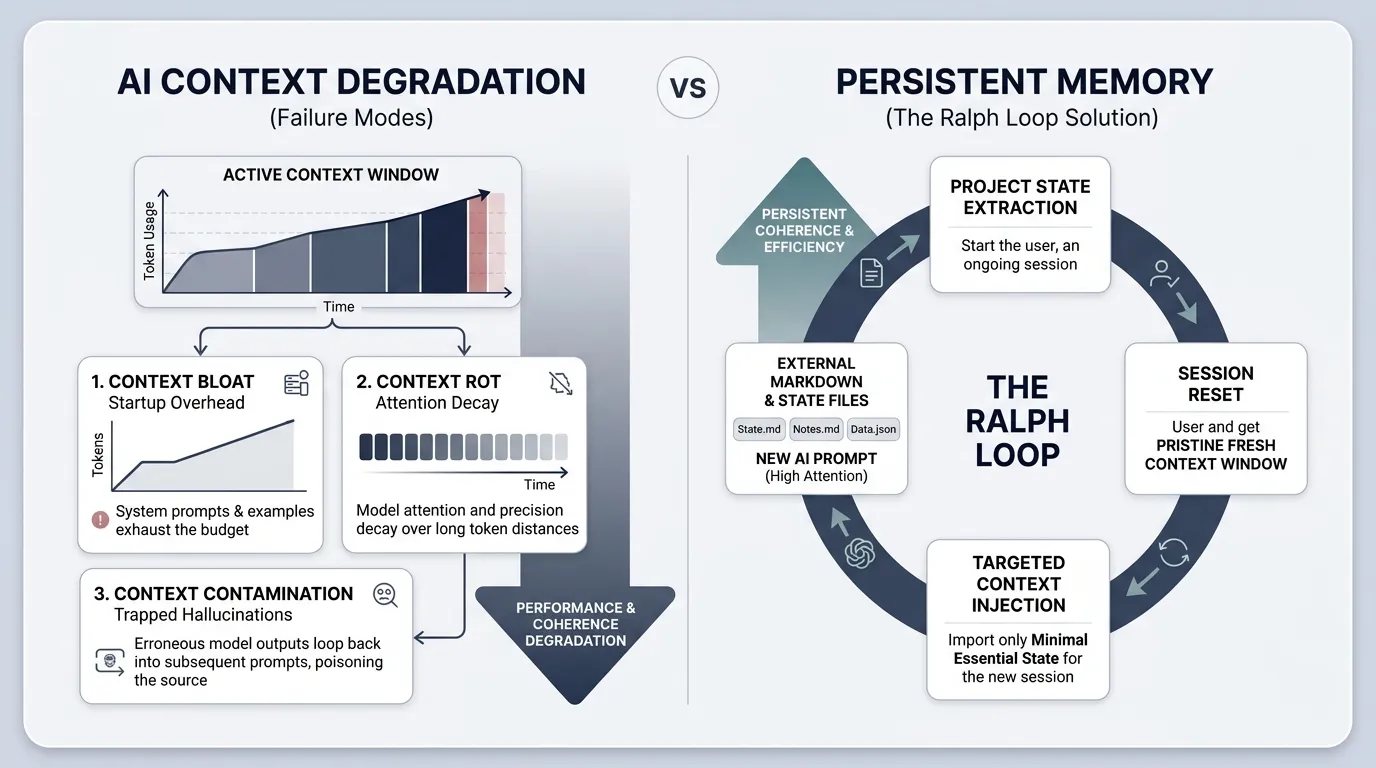
Context Window Failure Modes at a Glance
| Failure Mode | The Mechanism | The Symptom | Architectural Fix |
|---|---|---|---|
| Context Bloat | High startup token usage | System instructions, MCPs, and schemas consume 30%+ of the window before the first prompt. | Tier 2 Memory: Replace encyclopedic prompts with lightweight Level 3 routing files. |
| Context Rot | Attention degradation | Effectiveness drops significantly; AI ignores line-length limits or recent constraints. | The Ralph Loop Principle: Aggressive session termination and pristine context resets. |
| Context Contamination | Trapped hallucinations | AI apologizes for an error but repeats it because the initial mistake remains in the prompt history. | The Ralph Loop Principle: Extract state to external files and restart the session. |
The Architectural Fix : You cannot selectively purge past tokens or force a degraded session to un-rot. The structural solution relies on a simple principle: Aggressively terminate long-running sessions, extract vital state into external files, and restart with a completely pristine context window.
By resetting context regularly and persisting key architectural decisions externally, teams prevent context decay while keeping inference fast and focused. This need for external persistence is precisely where the Memory Ladder begins.
The AI Memory Ladder: Technical Architecture & Implementation
AI memory solutions form a distinct architectural continuum, moving from simple static text injection to distributed, multi-modal semantic graphs. The cardinal rule of AI systems engineering: Start at the lowest memory tier that satisfies your state-retrieval requirements, and only ascend when latency, context-window limits, or retrieval precision force a shift.
Tier 1: The Ground Floor
-
Level 1 | Static Rules & Repository System Instructions: File-based prompts (e.g.,
CLAUDE.md,.cursorrules, or repo-level XML guidelines) injected verbatim into every context window. Excellent for strict, immutable constraints such as code style, linter choices, and mandatory test frameworks, but consumes non-refundable input token budget on every single inference pass. -
Level 2 | Managed AutoMemory (Background Synthesis): Vendor-managed memory engines (e.g.,ChatGPT Personalization, Anthropic AutoDream) that asynchronously parse past session transcripts during idle time. These engines extract key entity preferences, past project names, and recurring developer habits, storing them in managed user profile stores. While effortless, they lack deterministic control and cannot be reliably audited for enterprise compliance or precise codebase state.
Tier 2: Structured Memory (The Practical Solution)
Before introducing vector database infrastructure, vector indexes, or embedding models, software architects should maximise Tier 2. This tier treats memory as a structured, deterministic file system navigated via explicit tool use and lightweight routing layers.
- Level 3 | State Files & Dynamic Context Routing: Instead of embedding encyclopedic knowledge directly into the root prompt, the primary instruction set acts purely as an API gateway. It maintains references to modular state files such as current execution subroutines or database schemas, and instructs the agent to read or update those targeted files on demand.
┌─────────────────────────────────────────────────────────────┐
│                       Dynamic State Router                  │
│                      (CLAUDE.md Structure)                  │
└──────────────────────────────-──────────────────────────────┘

# Project: Enterprise API Migration

## State Routing
- **Current Progress:** `docs/state.md` (read-write)
- **Schema Definitions:** `docs/database-schema.md` (read-only)
- **Architecture Decisions:** `docs/adr/` (on-demand lookup)

## Execution Policy
- **CRITICAL:** Never read all documentation files simultaneously into the context window.
- Load only the specific schema or ADR needed for the active sub-task.
- Update `docs/state.md` at the conclusion of every step prior to session termination.- Level 4 | Compiled Knowledge Vaults (The Digital Second Brain): Championed by systems researchers and AI engineers, this strategy utilizes an automated compile loop over markdown vaults like, Obsidian repositories or Git-backed documentation hubs. An LLM workflow periodically inspects new code commits, pull requests, and chat logs to compile summaries, bidirectional links, and index pages. This strategy requires zero vector database management, operates at negligible infrastructure cost, provides total version control, and maintains full human auditability.
Tier 3: Retrieval Systems (When Structured Files Fail)
When enterprise scale reaches tens of thousands of codebases, compliance records, real-time telemetry, or multi-modal assets, plain-text file navigation reaches its performance boundary. Tier 3 shifts to specialised indexing and retrieval pipelines.
-
Level 5 | Naive Dense Vector RAG: Ingestion pipelines chunk documents into text segments, generate dense embeddings (via models like text-embedding-3-large), and store them in vector databases (e.g., Pinecone, Qdrant, Milvus). While fast for simple keyword-adjacent queries, isolated vector chunks lose overarching context, often yielding lower accuracy on deep codebase reasoning or structural dependency lookups.
-
Level 6 | Graph RAG (Knowledge-Graph-Augmented Retrieval): Instead of isolated chunks, Graph RAG extracts entities, relationships, and semantic communities across the enterprise. Utilizing frameworks like LightRAG or Neo4j, the system traverses relational graphs alongside vector similarity. This approach provides significantly higher query precision on complex queries by connecting non-obvious dependencies e.g., linking a legacy database migration script to an unmapped microservice endpoint.
-
Level 7 | Multi-Modal Agentic RAG: The pinnacle of enterprise memory architecture. Autonomous agent routers evaluate incoming queries and dynamically choose between vector search, graph traversal, SQL analytical queries, or direct code AST inspection across text, audio, architectural diagrams, and video recordings. At this scale, the retrieval model itself is a small component. The primary operational overhead lies in data sync pipelines, automated chunk re-indexing, strict RBAC permissions enforcement, and real-time state synchronisation across active engineering teams.
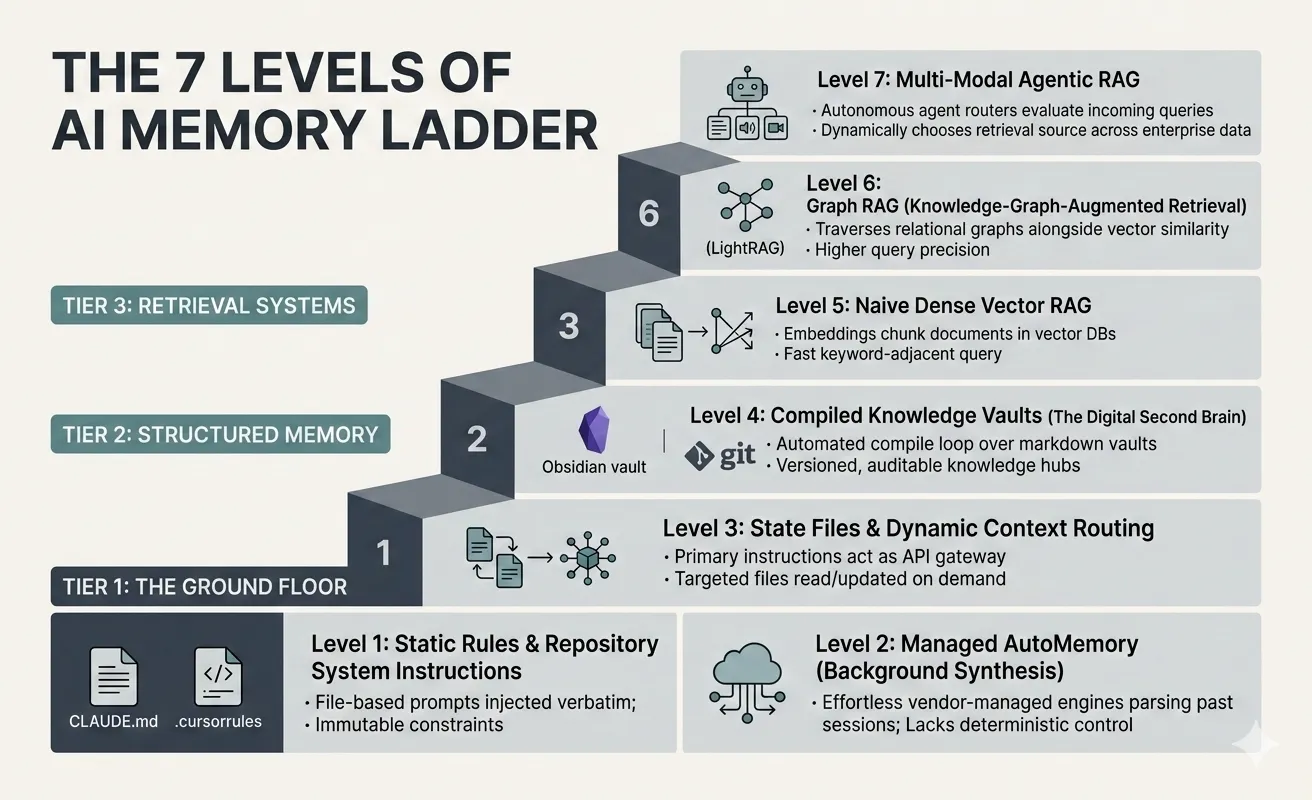
The 7 Levels of AI Memory: Architecture Matrix
| Tier | Level & Name | Core Mechanism | Infrastructure Cost | Ideal Enterprise Use Case |
|---|---|---|---|---|
| Tier 1. | 1. Static Rules | Manual file injection (.cursorrules) |
Zero | Immutable repo-level constraints (e.g., linters, syntax). |
| Tier 1. | 2. AutoMemory | Vendor background synthesis | Zero (Vendor managed) | Capturing individual developer habits and preferences. |
| Tier 2. | 3. State Routing | Dynamic context pointers | Zero | Active project state and API execution subroutines. |
| Tier 2. | 4. Knowledge Vaults | LLM-compiled markdown wikis | Negligible | Maintaining architectural decisions without vector DBs. |
| Tier 3. | 5. Naive RAG | Vector chunking & cosine search | Low to Medium | Keyword-adjacent queries and simple fact lookups. |
| Tier 3. | 6. Graph RAG | Entity & relationship traversal | Medium | Mapping non-obvious cross-document dependencies. |
| Tier 3. | 7. Agentic RAG | Cross-modal dynamic routing | High | Real-time, multi-modal enterprise production systems. |
The Bottom Line: The Architect’s Playbook
In enterprise AI engineering, the primary barrier to productivity is rarely raw model intelligence, it is fragmented organisational and persistent memory.
Without a deliberate memory strategy, engineering teams operate in isolated silos: frontend developers build context in one IDE assistant, backend engineers maintain separate sessions in another tool, and system architects store decisions in unindexed wikis. Every session reset reinstates the re-explanation tax, wasting compute budget and human time.
As language models become faster and less expensive, competitive advantage shifts from context window size to state management architecture. By enforcing strict session hygiene, establishing structured Level 3/4 Markdown state routers, and strategically deploying Level 6/7 Graph RAG only where relational scale demands it, software architects can eliminate context rot, lower operational expenses, and transform ephemeral AI chats into long-term digital colleagues.
Key Architectural Notes
These notes are synthesized and auto-generated by AI from the article content for quick reference.
What is the AI re-explanation tax?
The AI re-explanation tax is the recurring time and effort wasted at the start of every session when a user must re-teach the AI about project structures, architectural constraints, and previous decisions. This occurs because base language models lack persistent memory.
What is the difference between AI context and AI memory?
Context is the AI's active, ephemeral working memory, such as conversation history, loaded files, and system prompts, that disappears completely when a session ends. Memory is the persistent, structured architecture that securely stores state and decisions across multiple sessions.
Why does AI reasoning degrade in long chat sessions?
AI performance degrades in long sessions due to 'context rot' and 'context contamination.' As the context window fills, the AI spends excessive compute re-reading outdated exchanges, lowering its retrieval precision. If errors or hallucinations occur, they remain trapped in the context history, continuously poisoning the model's subsequent reasoning.
How do you fix AI context contamination?
Because you cannot surgically remove bad tokens from an active history, the only effective fix is the 'Ralph Loop' principle. This involves aggressively terminating the degraded session, persisting the current project state into external markdown files, and restarting with a completely fresh, pristine context window.
What is a Level 3 Dynamic State Router in AI?
A Level 3 Dynamic State Router involves using your core system prompt (like CLAUDE.md) purely as a lightweight index or API gateway rather than an encyclopedia. It instructs the AI to read specific, modular state files on demand, keeping the main context window lean and focused.
What are the 7 levels of the AI Memory Ladder?
The AI Memory Ladder outlines the progression of state management from simplest to most complex: (1) Static Rules, (2) Managed AutoMemory, (3) State Files & Routing, (4) Compiled Knowledge Vaults, (5) Naive Dense Vector RAG, (6) Graph RAG, and (7) Multi-Modal Agentic RAG.
What is Anthropic AutoDream?
Anthropic AutoDream represents Level 2 Managed AutoMemory—an asynchronous background synthesis engine that processes past session transcripts during idle time. Inspired by biological memory consolidation, it automatically extracts recurring preferences, project entities, and developer patterns into persistent profiles without manual note-taking, though it lacks deterministic auditability for enterprise codebases.
Why is Graph RAG better than Naive Vector RAG for enterprise AI?
Naive Vector RAG retrieves isolated chunks of text based on keyword or semantic similarity, often missing the broader context. Graph RAG extracts specific entities and their relationships, building a navigable semantic network. This allows the AI to traverse non-obvious dependencies, improving retrieval accuracy for complex architectural queries.