Demystifying the AI Harness: What Makes Enterprise AI Actually Work
In Enterprise AI, a harness is the software infrastructure wrapped around a language model that turns it from a raw text generator into a functional, reliable AI agent. A popular industry shorthand defines this relationship simply: Agent = Model + Harness.
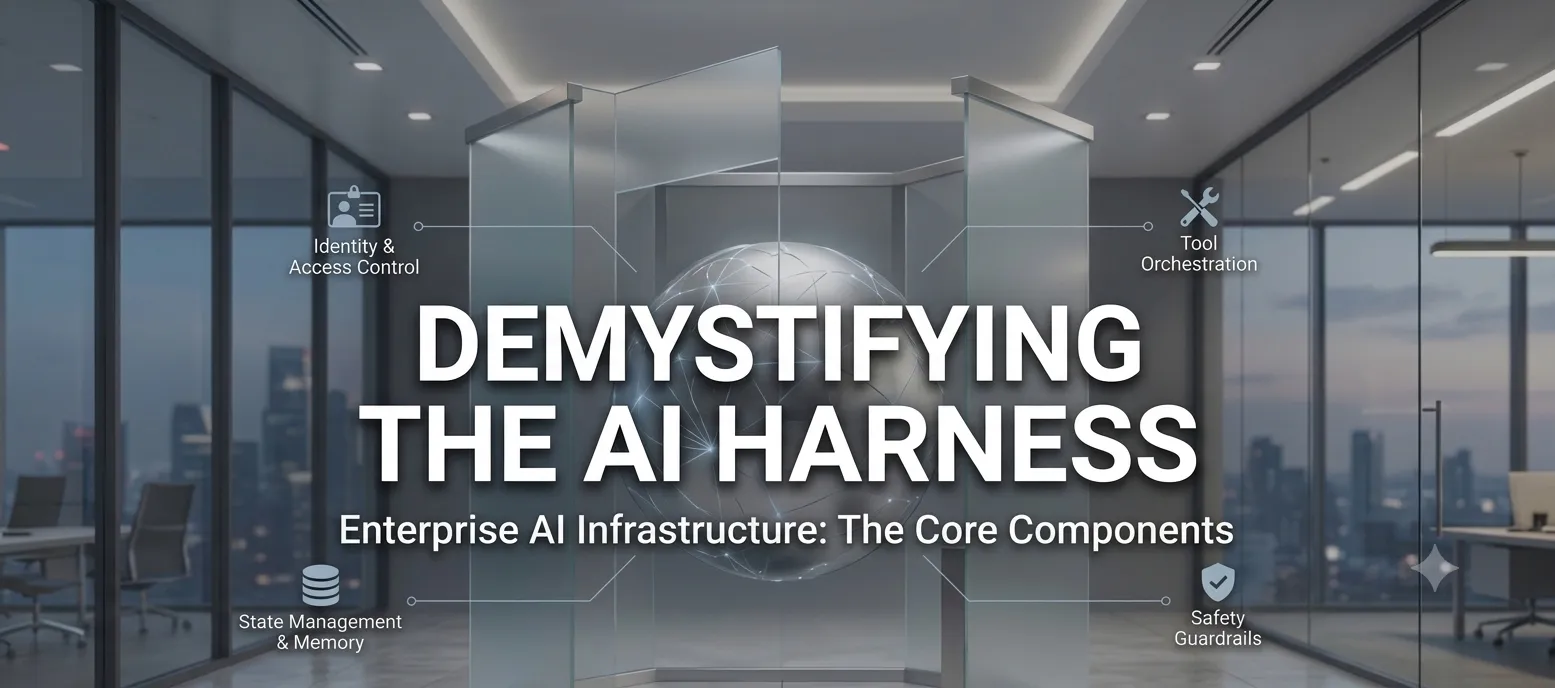
If you spend enough time in enterprise technology right now, you’ll notice a distinct shift in the conversation. We are now talking about the Harness and how to apply it in the enterprise space
In simple terms, a harness is the software infrastructure wrapped around a language model that turns it from a raw text generator into a functional, reliable AI agent. A popular industry shorthand defines this relationship simply: Agent = Model + Harness.
If the AI model is the brain, the harness is the software body wrapped around it. It is the operating system, the steering wheel, the brakes, and the security badge that allows that brain to safely execute work in the real world.
Without a harness, a model is just a stateless text generator. With a software harness, it becomes a functional digital worker.
The Consumer Experience: ChatGPT and Local Models
To understand the difference, let’s look at how we consume AI today.
You can go online right now, download a powerful open-weights model like DeepSeek, and run it locally on your laptop using a tool like Ollama. Or, you could ping a platform like AWS Bedrock to send text directly to a raw model via API. If you do this, you’ll quickly realize something: it can’t do most of the things ChatGPT can do, like browsing the web or remembering what you told it yesterday. The model is completely isolated.
So why do ChatGPT and Claude feel so much more powerful?
Because OpenAI and Anthropic didn’t just build models; they built massive, highly engineered software harnesses around them. When you ask ChatGPT to analyze an Excel file, the raw model isn’t doing the math. The model writes a Python script, hands it to the harness, the harness executes that code in an isolated sandbox, captures the result, and feeds it back to the model to explain to you.
The product you love isn’t just the model. It’s the model operating inside the software harness.
The Enterprise Experience: Microsoft 365 Copilot
Let’s apply this to a corporate environment using a tool many of us already rely on: Microsoft 365 Copilot.
The underlying AI model powering Copilot is essentially the same reasoning engine you can access on the public web. But when you use Copilot inside your corporate tenant, you can ask it to “Summarize the Teams meeting I had yesterday and draft an email based on the PowerPoint I shared”.
The model alone cannot do that. Microsoft had to build an enterprise-grade software harness to bridge the gap. In this scenario, the harness provides:
- Data Connectivity: It queries the Microsoft Graph to securely find the presentation and meeting transcript.
- Tool Orchestration: It leverages standard integration frameworks like the Model Context Protocol (MCP) to interface with the Exchange and APIs to actually draft the email.
- Identity and Access Controls: Crucially, it enforces your personal permissions. If you ask Copilot for the company payroll, the harness checks your Active Directory permissions, sees you aren’t in HR or Payroll, and blocks the model from ever seeing those files.
Why the Harness is the Secret to Enterprise AI
The underlying AI models are becoming commoditized; they are all getting faster and smarter with each release. The true engineering challenge, the real risk management, and the proprietary business value all reside in the software harness.
Here is why the harness is non-negotiable for an enterprise setup:
-
The Control Loop and State Management: Raw models have no memory; they treat every single prompt as a blank slate. To get real work done, enterprise harnesses use what we call a ReAct (Reason + Act) loop. If we ask an AI agent to reconcile 500 invoices, the harness maintains the “state.” It feeds the model one invoice, runs the database tool the model requests, observes the result, and loops back. The software harness keeps the agent on track without looping infinitely or losing its place.
-
Sandboxing and Execution Boundaries: An unharnessed AI is a massive liability. If you want an agent to write code or update a database, you cannot let it do so unsupervised. A robust harness provides an isolated execution environment (a sandbox). It allows the model to test its work, fail safely, and try again without ever touching production data or causing a catastrophic system failure.
-
Identity, Guardrails, and RBAC: You cannot build an enterprise AI without strict Role-Based Access Control (RBAC), which makes enterprise AI primarily a governance problem. The harness acts as a continuous security checkpoint. The harness acts as a continuous security checkpoint. Before the model’s intended action is executed, the harness validates it against corporate policies. It prevents data leakage, blocks malicious prompt injections, and ensures the AI only interacts with systems it is explicitly authorized to touch.
-
Observability and Traces:
When a standard software script fails, you check the error logs. When an AI agent fails, you need to know why it made the decision it did. The harness records the exact trajectory of every task—the prompt, the context retrieved, the tools called, and the reasoning used. This audit trail is mandatory for compliance, debugging, and continuous improvement. -
Model Abstraction (Future-Proofing): The AI landscape changes weekly. The model that is state-of-the-art today might be obsolete next quarter. A well-designed harness abstracts the model away from your business logic. If a cheaper, faster model is released tomorrow, we simply unplug the old “brain” and plug the new one into our existing software harness. We don’t have to rebuild our security protocols or database connections.
The Bottom Line
When we talk about bringing AI into the enterprise, we aren’t just deploying smart chatbots. We are engineering the software infrastructure, the memory, the sandboxes, the security, and the loops, that transforms a raw reasoning engine into a safe, reliable digital colleague.
The model sets the ceiling on how smart your AI can be (though you shouldn’t use your smartest model for everything). But the harness sets the floor on how useful and safe it actually is.
Key Architectural Notes
These notes are synthesized and auto-generated by AI from the article content for quick reference.
What is an AI Harness?
An AI harness is the software infrastructure wrapped around a foundation model that manages memory, executes tools, enforces security guardrails, and maintains state. While the model acts as the reasoning brain, the harness provides the software body required to safely execute actions in real-world systems (Agent = Model + Harness).
What is the difference between an AI model and an AI agent?
In enterprise architecture, the relationship is defined as Agent = Model + Harness. The AI model acts as the reasoning 'brain,' while the harness provides the software 'body' required to execute actions, connect to databases, and navigate corporate workflows.
Why do enterprises need an AI harness instead of just using raw models?
Raw models are isolated, stateless, and lack corporate permissions. An enterprise harness provides critical infrastructure like data connectivity (APIs), tool orchestration, Role-Based Access Control (RBAC), and sandboxed execution environments to ensure AI tasks are performed securely and accurately.
How does an AI harness prevent infinite loops and memory loss?
Harnesses utilize a ReAct (Reason + Act) control loop to maintain state management. Because raw models lack memory, the harness tracks step-by-step progress, feeds the model relevant context, and ensures long-running tasks reach completion without losing their place.
What is model abstraction in an AI harness?
Model abstraction future-proofs enterprise AI by decoupling business logic from specific model providers. A well-designed harness allows organizations to unplug an outdated model and plug in a newer, cheaper one without rebuilding security protocols or integrations.
How does Microsoft 365 Copilot use an AI harness?
While Copilot uses a standard reasoning model, its enterprise power comes from its harness. The harness queries the Microsoft Graph for specific user files, orchestrates actions across Office apps, and strictly enforces personal Active Directory permissions to prevent unauthorized data access.
What are the core components of an enterprise AI harness?
The core components of an enterprise AI harness include: (1) a ReAct control loop for state and memory management, (2) isolated sandboxes for secure tool execution, (3) Identity and Role-Based Access Control (RBAC) guardrails, (4) immutable audit logging and tracing, and (5) model abstraction layers for provider independence.