Remember When OpenClaw Was The Future?
Five years from now, users won't care whether a feature uses an AI agent, MCP and RAG. They'll simply expect the software to work.
Six months ago, it was almost impossible to scroll through LinkedIn or X without seeing someone talk about OpenClaw.
People were buying Mac Minis specifically to run it 24×7. Every other post showed screenshots of autonomous agents. Some claimed their AI was managing emails, others said it was replacing entire workflows, and a few even suggested it was running parts of their business independently.
If you only followed social media, you would have believed that autonomous AI agents had already arrived.
Fast forward to today.
Almost nobody is talking about OpenClaw anymore. Did it fail? Not really. Did everyone suddenly discover it was useless? No.
The hype simply moved on.
That observation made me realise something interesting, not about OpenClaw, but about the AI community itself.
The AI Community Has an Incredibly Short Attention Span
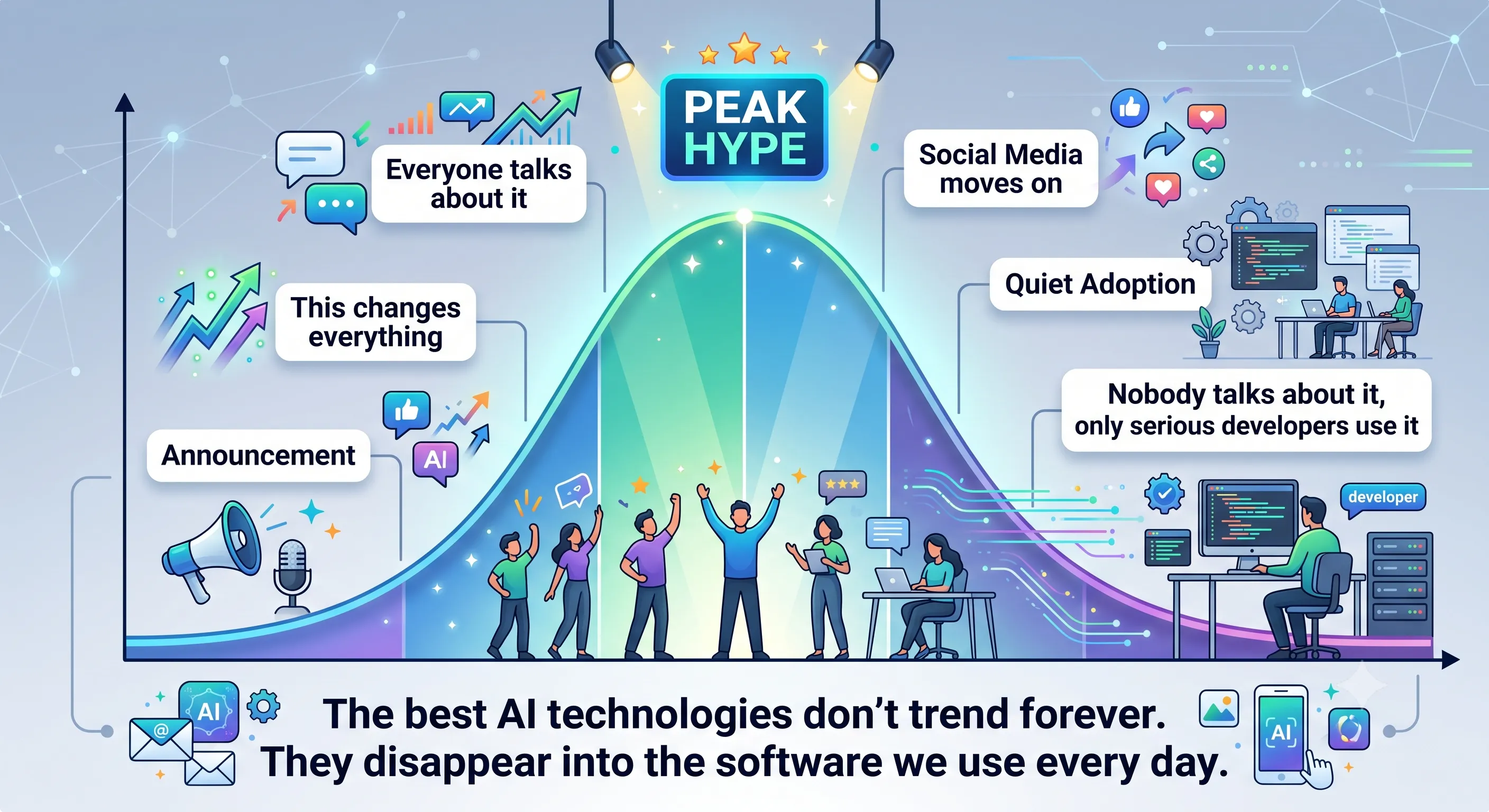
Over the past few years, I’ve noticed that almost every AI breakthrough follows the same lifecycle. Someone releases a new model, framework, protocol, or product. The internet reacts instantly.
Within days, social media is flooded with screenshots, hot takes, tutorials, and bold predictions about how “everything has changed.” Then the excitement peaks. Every podcast covers it. Every influencer posts about it. Every conference mentions it. Every developer feels they’re already falling behind.
Then, just as quickly as it appeared… Everyone starts talking about something else.
The pattern is surprisingly consistent.
Week 1: “This changes everything.”
Week 3: “Everyone must use this.”
Week 8: “This is the future.”
Week 12: Everyone is talking about something else.
Week 20: Serious developers are quietly using it every day.
Notice something interesting? The final stage receives the least attention, despite being the one that actually matters.
We’ve Seen This Before
OpenClaw isn’t unique. The same cycle has repeated itself with almost every major AI innovation. First it was prompt engineering. Then vector databases. Then RAG. Then local LLMs. Then AI agents. Then MCP. Then vibe coding.
Each one dominated our feeds for weeks. People declared it the next revolution. Some declared it dead just a few months later.
But in reality, neither statement was completely true. The technology simply became… normal.
Hype Is Loud. Adoption Is Quiet.
Social media optimises for novelty. Engineering optimises for reliability. Those are very different incentives.
A developer doesn’t wake up every morning looking for the newest framework. They want tools that solve problems.
That means once a technology becomes stable enough to integrate into production, it often becomes less interesting to talk about.
Ironically, that’s when it becomes most valuable.
Nobody writes viral posts saying,
“Our authentication service worked flawlessly for the 900th consecutive day.”
Nobody gets thousands of likes for saying,
“We’ve been using PostgreSQL successfully for five years.”
The same thing happens with AI. Once a technology starts quietly delivering value inside real products, it stops generating headlines.
The conversation moves elsewhere. The work continues.
The Influencers Move On. The Builders Don’t.
The people chasing attention have to keep moving. Their audience expects something new every week.
But builders don’t have that luxury. Builders still have bugs to fix, customers to support, systems to scale, security reviews to pass, budgets to justify, production incidents to investigate.
They don’t replace a working solution every month simply because a newer one is trending on X.
Instead, they keep improving what already works. That’s why the technologies that quietly survive the hype cycle often become the foundation of tomorrow’s software.
Maybe We’re Measuring the Wrong Thing
We often judge the importance of a technology by how much people are talking about it. But popularity is a poor proxy for usefulness.
If anything, the opposite is often true.
When everyone is talking about a technology, expectations are usually at their highest. When almost nobody is talking about it anymore, engineers have finally had enough time to understand its strengths, limitations, and practical use cases.
That’s when adoption begins. Not with viral posts, but with production deployments.
The Real Lifecycle of AI Innovation
Looking back, OpenClaw wasn’t the story. It was simply the latest example.
Every major AI breakthrough seems to go through the same journey:
-
Discovery
-
Hype
-
Unrealistic expectations
-
Disappointment
-
Quiet adoption
-
Integration into everyday software
By the time the internet has moved on to the next breakthrough, thousands of developers are still building with the previous one.
Most users never notice. And that’s exactly the point.
The best technologies eventually become invisible. Nobody opens a browser and thinks about the JavaScript engine. Nobody sends an HTTPS request and celebrates TLS. Nobody asks whether their IDE uses incremental compilation.
Those technologies became infrastructure.
I suspect the same thing will happen with many of today’s AI innovations. Five years from now, users won’t care whether a feature uses an AI agent, MCP, RAG, or something that hasn’t even been invented yet.
They’ll simply expect the software to work.
And perhaps that’s the ultimate success of any technology.
The best AI technologies don’t trend forever. They disappear into the software we use every day.