Architecture Built on Architecture: Why John Locke’s Philosophy Explains Enterprise Systems
Stop chasing the greenfield illusion. Discover why modern enterprise architecture is cumulative, and how to build resilient systems on top of legacy foundations.

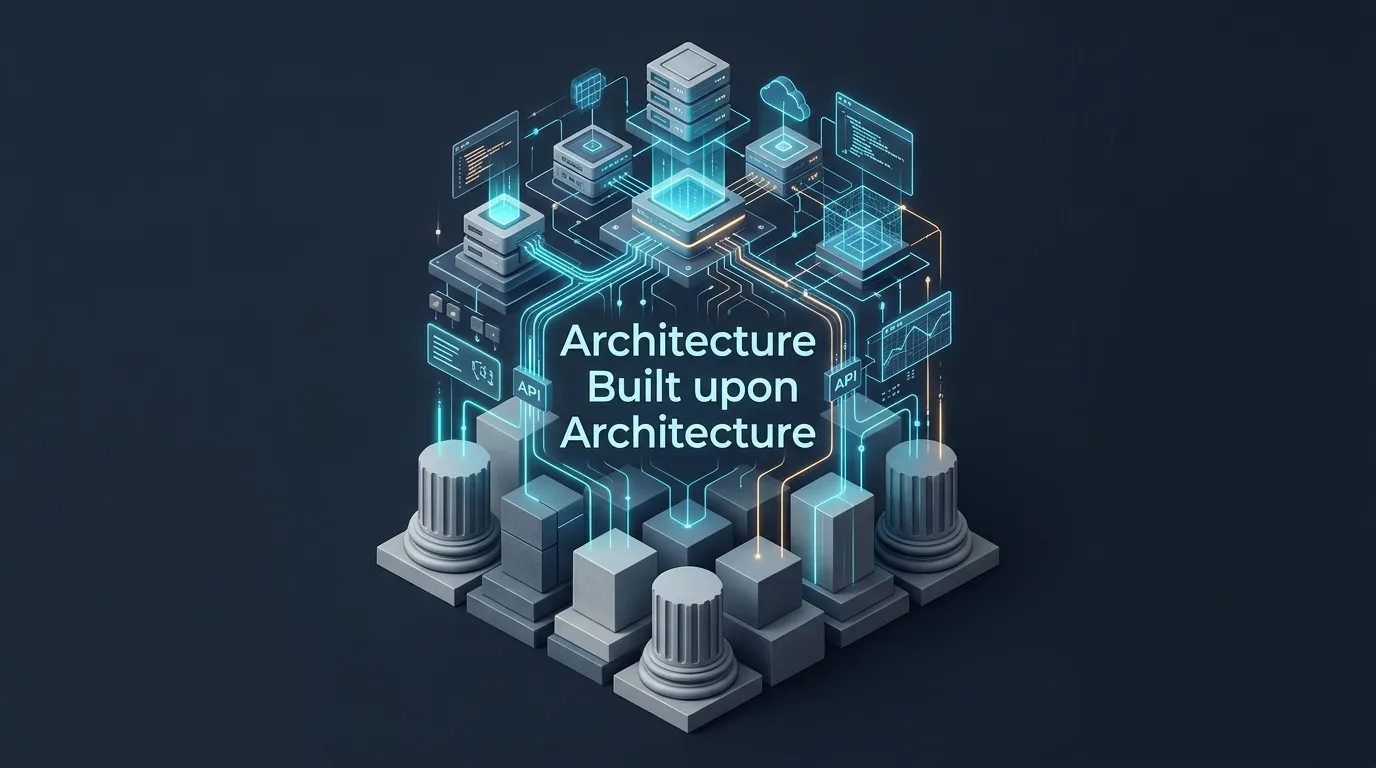
While listening to the lecture of the DiMAP course (Diploma Training Course in Modern Applied Psychology) recently, a simple philosophical concept stopped me in my tracks: complex ideas are never born out of thin air - they are built upon simpler ideas.
I immediately saw the parallel to the systems we build and maintain every day. Just as ideas are built upon ideas, architecture is built upon architecture, and systems are built upon systems.
Every few years, the tech industry falls in love with the myth of the “clean slate.” A new framework comes out, a mandate to move to the cloud is issued, or a rush to adopt AI takes over. The immediate instinct in the team is to declare the existing setup obsolete, to tear it all down and build a perfect, brand-new system from scratch.
But in the real world of enterprise environments, starting from scratch is an illusion. Modern enterprise architecture is never created in a vacuum. Every shiny new digital storefront, cloud migration, or microservice sits right on top of decades of existing business logic, regulatory rules, old data models, and historical design choices.
The Fallacy of the Blank Slate
Back in the day, the philosopher John Locke wrote that the human mind starts as a blank slate. He argued that we construct complex knowledge slowly, by combining and layering simple ideas based on our everyday experiences.
While a newborn mind might start blank, a functioning enterprise never does. By the time a company is large enough to need an Enterprise Architect, its slate is already full. It is crowded with old legacy workflows, complex inter-dependent systems, compliance rules, and battle-tested business logic.
When teams ignore this reality and treat a system transformation as an isolated, brand-new project, we consistently see four predictable failures:
-
The Hidden Complexity Tax: When we try to rewrite an old system, we often think we are just deleting “messy” code. But usually, that mess is there for a reason. It is not just bad programming; it represents ten years of hard-learned business rules, obscure regulatory laws, hardware bottlenecks and necessary compliance checks. If you start from scratch, you don’t erase that complexity. You simply end up discovering those exact same problems all over again, halfway through the project, when it is too late to change course easily.
-
The Distributed Monolith: We often assume that breaking a massive, clunky old system into smaller, modern pieces (microservices) will make everything faster and easier to manage. But if we just chop up the code without carefully untangling how the underlying data actually works together, we haven’t fixed the core problem. We have just taken our old, tangled mess and spread it out across the network. Now, when one small piece fails, the whole system still crashes, but it is much harder to track down exactly where the failure happened.
-
The Kitchen Wiring Problem: As I wrote recently regarding the microwave era of AI, you cannot drop high-powered, modern tools into a broken foundation. It is like buying a top-of-the-line appliance and plugging it into a house with old, sparking electrical wires. You cannot just bolt generative AI, shiny dashboards, or real-time analytics onto data that is undocumented and fragmented. The house has to be wired correctly first, or the new technology simply won’t turn on.
-
The “Big Bang” Illusion: This is the dangerous belief that we can simply flip a switch to turn off the old legacy system on a Friday, and turn on the perfect new system on a Monday. Because the old system is deeply tied into so many other parts of the business, these sudden cutovers almost always fail. We forget that the old architecture wasn’t just software; it was the nervous system of the company. It has to be evolved and shifted gradually, not amputated overnight.
Locke’s Operations Applied to System Design
In Locke’s framework, the mind turns simple thoughts into complex knowledge through three distinct actions: Combination, Relation, and Abstraction. Modern enterprise architecture relies on these exact same mechanisms to evolve naturally over time.
-
Combination (Putting the blocks together): Just as the mind combines simple shapes and colors to understand the concept of a physical object, we use domain-driven design. We take small, individual services, like a user login, a payment gateway, and an email notification, and combine them to create a larger, cohesive business journey, like opening a new bank account.
-
Relation (Connecting the dots): Locke talked about comparing and connecting two distinct ideas without merging them together. In architecture, this is how we connect independent systems using event streams and unified tracing. Instead of tangling databases together, we let systems securely pass messages to one another, keeping them related but functionally independent.
-
Abstraction (Hiding the messy details): The human mind separates shared traits from specific instances to create general concepts. In our world, we build developer platforms and API gateways. We hide the messy, complicated details of legacy mainframes or cloud providers behind clean, simple, and standardized interfaces.
When an enterprise system fails to scale, it is almost always because we skipped one of these steps. We try to build complex AI agents (Combination) before we have clean APIs (Abstraction) and reliable data streams (Relation) in place.
The Architect’s Playbook: Designing for Cumulative Scale
If we accept that today’s bleeding-edge platform is tomorrow’s legacy system, our job fundamentally changes. We stop optimizing purely for speed of initial delivery and start optimizing for evolvability. We ensure that the architecture we build today is strong and clean enough to support the innovations that will inevitably be built upon them five or ten years from now.
1. Treat Legacy as a Domain, Not a Disease
To do this, we need to treat legacy systems with respect. Stop framing old systems purely as a technical debt to be eradicated. Instead, wrap them carefully. Use translation layers to turn old, clunky data into clean, modern events. This protects your new architecture from historical quirks while preserving decades of proven business logic.
2. Standardize the Connective Tissue
When systems are layered over decades, the seams between them become the primary points of failure. Governance should focus relentlessly on the boundaries rather than dictating internal application code.
Enforce strict contracts (like OpenAPI or AsyncAPI schemas) at every API endpoint. Also, as I covered in Distributed Tracing: Why TraceID is an Architectural Mandate, propagate Trace Context across both synchronous HTTP calls and asynchronous message queues so any transaction can be traced from the newest mobile UI down to the oldest mainframe query.
3. Build Subtractive Abstractions
Great foundations reduce cognitive load for the teams building above them. Instead of forcing every product squad to wrestle with raw cloud IAM policies, vendor-specific logging SDKs, or compliance encryption rules, bake those primitives into standardized platform wrappers. When you abstract the plumbing, future teams can focus entirely on composing new business value.
The Pragmatic Reality
Great architecture is rarely a monument built in isolation. It evolves layer by layer, each one supporting the next.
John Locke understood that human wisdom is cumulative. No complex thought is possible without the quiet, unglamorous work of simple ideas holding it up. Enterprise architecture is exactly the same.
The true measure of an architect isn’t how fast they can tear down the past to build something shiny. It is how well they design the foundations today, so that the next generation of builders has solid ground to stand on.
Key Takeaways
These key takeaways are synthesized and auto-generated by AI from the article content for quick reference.
Why do greenfield enterprise architecture projects fail?
Greenfield projects in enterprise environments usually fail because they treat legacy systems as bad code to be deleted, rather than essential business rules to be preserved. This triggers the 'Hidden Complexity Tax,' where engineering teams inevitably rediscover and are forced to rebuild decades of undocumented compliance, tax, and operational edge cases, leading to massive delays and budget overruns.
What is the 'Kitchen Wiring Problem' in enterprise AI and IT architecture?
The 'Kitchen Wiring Problem' is an architectural analogy for trying to implement advanced technologies—like generative AI or real-time analytics—on top of broken, undocumented, or fragmented data foundations. Just as you cannot safely plug a high-powered modern appliance into frayed electrical wiring, an enterprise cannot deploy reliable AI without first fixing and standardizing its underlying data architecture.
How should enterprise architects handle legacy systems and technical debt?
Enterprise architects should treat legacy systems as a core business domain rather than a disease to be eradicated. Instead of attempting highly risky 'rip-and-replace' migrations overnight, architects should use the Strangler Fig Pattern. This involves building Anti-Corruption Layers (ACLs) to wrap legacy databases in clean, modern APIs, preserving the proven historical business logic while allowing new capabilities to be built safely on top.
What is a distributed monolith in microservices architecture?
A distributed monolith occurs when a large legacy system is chopped into smaller microservices without untangling the underlying data dependencies. Instead of decoupling the system, the tight coupling is simply spread across a network. As a result, a failure in one small service still brings down the entire system, but the root cause is now significantly harder to trace and debug.